Showing posts with label Sony Alpha NEX-7. Show all posts

Friday, February 7, 2014

Shootout - Fujifilm X100 vs Sony Alpha NEX-7 vs Nikon D600 - 35mm Equivalent Battle!

Based on the popularity of the last Shootout series (found here: The Pentax Q vs NEX-7 vs D600, and The Sequel) that I've posted on this website, I now follow up with the ultimate battle at 35mm-equivalent views.

The contenders today are all highly commended individuals, scoring many wins in their respective categories.

The Fujifilm X100 is a fixed-lens APS-C camera launched in 2010. The Sigma DP series came earlier, around 2006, but I think the Fujifilm X100 really brought large-sensor compact cameras into popular use. The X100 was also the first to feature a hybrid optical-electronic viewfinder, comes with a high quality 23mm F/2.0 Fujinon fixed lens, and 12 megapixel sensor. It also launched the entire X-series for Fujifilm, which now mostly focuses on X-trans sensors (the X100 features a traditional Bayer type sensor).

The Sony Alpha NEX-7 was one of the first enthusiast level mirrorless interchangeable lens cameras, with a 24 megapixel sensor that is still among the top of APS-C size sensors. For this review, the NEX-7 has been paired with the Carl Zeiss Sonnar E 24mm F/1.8 lens, which is generally regarded as a top quality prime lens.

The Nikon D600 is also a very special camera, being the first to bring down the size of a full frame DSLR. It also features a 24 megapixel sensor, but covering a full frame (FX) area. Here it is paired with the Sigma Art Series 35mm F/1.4, also regarded as one of the top prime lenses for DSLR users (and often preferred over the Nikon and Canon equivalents).

All three options today offer an equivalent view of approximately 35mm in full frame terms, with real apertures ranging from F/1.4 to F/2.0.

Figure 1 - The Shootout Contenders - Nikon D600, Fujifilm X100, Sony NEX-7


Let's compare some statistics of these three options:

Fujifilm X100
- Size: 126 x 75 x 63 mm [W x H x D]
- Weight: 445 g (including lens and battery)
- Sensor: APS-C

Sony Alpha NEX-7
- Size: 124 x 70 x 110 mm [W x H x D]
- Weight: 353 g (including battery) + 224 g (lens) = 577 g
- Sensor: APS-C

Nikon D600
- Size: 142 x 116 x 160 mm [W x H x D]
- Weight: 850 g (including battery) + 665 g (lens) = 1515 g
- Sensor: Full Frame

Size is measured as an imaginary box containing the entire camera and lens.

So as we can see, from both Figure 1 and the statistics, that we have a wide range of sizes and weights, but all offering the same effective perspective when taking photos. There are some obvious differences in operation, such as autofocus speeds and accuracy, continuous burst shooting, manual settings, etc. In this review we are mainly focusing on the camera sensor-lens combo, and the image quality judged mainly by sharpness.

Test Scene

The test scene was set up to have fine details, mainly to test the resolving power of the sensor and lens combos for the three cameras. The key details are in the centre of the frame, where maximum sharpness is expected.

Figure 2 - Test Scene for 35mm Shootout Battle

Photo Settings

In an attempt to compare the three cameras in a fair manner, I've selected some settings that should equal the playing field for the lenses and represent a normal scenario for the sensors.

  • All cameras set to Manual mode, fixed ISO
  • ISO set to 400
  • Lens are all prime, approximately equivalent to 35mm view on full frame.
  • Aperture set to F/2.8, shutter speed 1/30s
  • Contrast-detect autofocus where possible, to minimise error in AF-fine tune for phase-detect methods.
  • Multiple photos per camera, sharpest selected. 
  • Crops taken close to centre of photo.
  • All images shot in RAW format, processed in Lightroom with default settings, white balance correction, and exported to JPG.

Full resolution crops of the centre of the test scenes are available here:

Figure 3 - Sony NEX-7
Figure 4 - Nikon D600
Figure 5 - Fujifilm X100
 
Immediately there are obvious differences in the exposure. The Nikon D600 image is clearly brighter than the other two, although exposure settings were supposedly equal. This can be due to different cameras reporting their ISO inaccurately, and some lenses being more efficient at transmitting light. The white balances were also a bit different, so that was corrected in Lightroom.

Comparison of Centre Details

Figure 6 - Comparison Whole Scene

With the first comparison we compare the whole scene detail. The obvious difference in exposure does make the Nikon D600 image look better, but otherwise the details seem quite similar. It is noteworthy that the D600 image has less depth-of-field than the other two cameras, which is due to it using a full frame sensor but same aperture as the other two APS-C size cameras. We could choose a smaller aperture to match the effective depth-of-field, but this would impact the exposure.

Let's take a closer look at some details.

Comparison Crop A

First up lets see a crop centred on the fine black & white text detail on the packaging on the left.

Figure 7 - Comparison Crop A
The three images were resampled to give the same effective resolution. This puts the Fujifilm X100 at a disadvantage, since it has a lower resolution sensor.

The Fujifilm X100 image is definitely less sharp, with the text being less readable, and less definition in the fur of the soft toy. The NEX-7 and D600 images look a lot closer, with the text being equally readable. I'd say that the NEX-7 image seems slightly sharper, but also with more visible noise occurring.

Comparison Crop B

Our second crop focuses on the package of toy erasers in the centre, which has colour and more low contrast detail.

Figure 8 - Comparison Crop B

Similar observations are made for this second comparison. The Fujifilm X100 clearly has less detail than the other two, with everything appearing a little soft.

The NEX-7 and D600 are again hard to differentiate in terms of pure detail, but I'd give the edge to the D600 due to less appearance of noise. This difference may have been a benefit of the brighter exposure on the D600.


Conclusions

In conclusion I'd say that the results are pretty close to my expectations. The Fujifilm X100 is a lot of fun, and produces high quality images, but cannot compete with the Sony NEX-7 which is one of the best resolution APS-C cameras, and the D600 which is full frame.

The NEX-7 is very close to matching the D600 in this test, and that is very impressive given that it is older and significantly smaller. The benefits of taking the Nikon D600 over the Sony NEX-7 would have to be the bigger aperture/sensor combo (being able to produce images with less depth-of-field), as well as the superior focusing with a proper phase-detect AF system.

Wednesday, December 5, 2012

Shootout - The Sequel

This is a follow-up to the Shootout: Pentax Q vs Sony NEX-7 vs Nikon D600 that was reported previously. Following some feedback provided by readers on the methodology used in the previous shootout, a new test has been performed which hopefully improves upon the comparison.

For details regarding the test and cameras involved, please see the previous post:

The following scene was shot under these conditions:
  • Base ISO, which is ISO 100 for the NEX-7 and D600, and ISO 125 for the Pentax Q.
  • Focal length approximately 50mm equivalent.
  • Aperture of F/5.6.
  • Focus achieved using contrast detect autofocus. 
  • All shot in RAW format and processed to JPG using Lightroom with no corrections, except:
    • White balance corrected in Lightroom.
    • Exported at 1600 pixels wide.


The full test scene as shot on the Sony NEX-7, 50mm equivalent focal length.

The full test scene is shown in the photo above. I won't bother repeating this for the other two cameras, as you can't see much at this scale.

The following images were cropped to show the same view, and resized to 1600 pixels wide. This represents a 100% crop on the Pentax Q, and approximately 62% crop on the NEX-7 and D600. These cropping percentages apply only when image is viewed full size at 1600 pixels wide.

Pentax Q - Cropped to 100%

Sony NEX-7 - Cropped to 62%

Nikon D600 - Cropped to 62%

This is where we get to the meat of the review. Cropped to this scale, differences between the three cameras are more obvious.

We'll start with an assessment of the Pentax Q, the image is blurry and fuzzy. The colour reproduction is not too bad, but everything lacks clarity. A commenter on the previous Shootout review suggested that the Pentax Q may not have focused properly, so this time I tried to achieve good focus. Again I have not been able to shoot a sharp image under these conditions, so either this is the true performance of the sensor, or the autofocus is very unreliable. I did try autofocus multiple times, and also attempted manual focusing without much success.

The Sony NEX-7 and Nikon D600 do much better, as we'd expect. The small text appears slightly sharper in the D600 image compared to the NEX-7, but this advantage is offset by the obvious false colour being introduced into the image with the extreme details (such as the band of vertical lines at marker 6). Let's go for a closer crop for finer comparison, the following images are 100% crops from the D600 and the NEX-7.

Sony NEX-7 - Cropped to 100%

Nikon D600 - Cropped to 100%

These crops further reinforce the previous comments. The D600 shows sharper text but with the disadvantage of false colour in areas of extreme detail. The NEX-7 on the other hand handles those details in a more pleasing manner. This might suggest a weaker anti-aliasing filter on the D600 compared to the NEX-7. It should be noted that the NEX-7 has a higher pixel density than the D600, which may also be a factor in avoiding false colour arising from fine details.

Dynamic Range

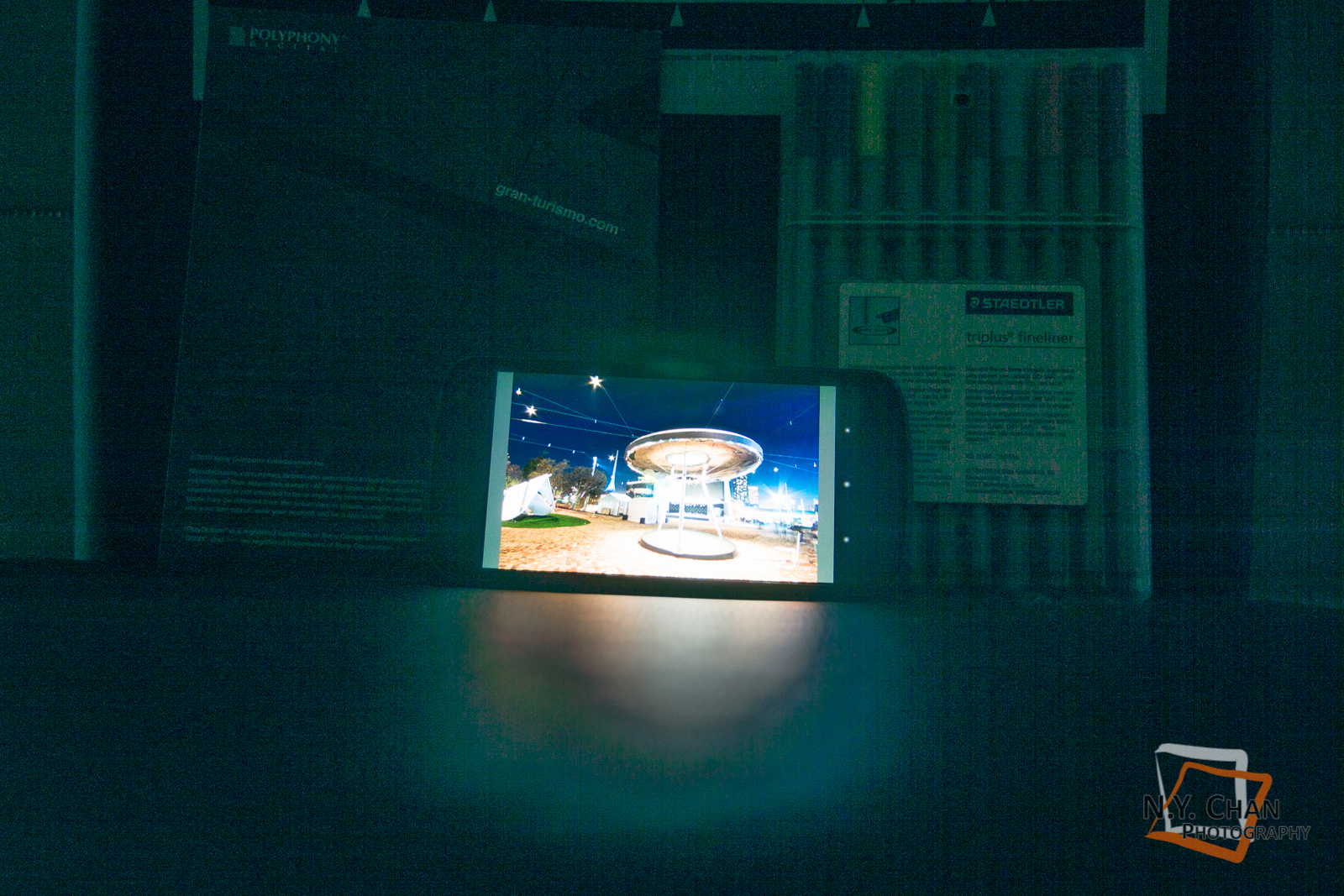
The following image tests the dynamic range of the three cameras. Dynamic range refers to the ability of the camera sensor to capture both details in dark areas at the same time as bright areas (i.e. being able to see inside a cave while retaining correct exposure in brightly sun-lit areas).

A simple method was designed to test this performance measure. The room lighting is now set to a very dim level, and a bright light source is introduced into the image, which in this case is a cellphone screen. The image is exposed correctly for the cellphone, leaving the dark areas completely black. An attempt is then made during postprocessing to recover the shadow details.

Details for this image:

  • Base ISO, which is ISO 100 for the NEX-7 and D600, and ISO 125 for the Pentax Q.
  • Focal length approximately 50mm equivalent.
  • Aperture of F/4.5, shutter speed of 0.3s.
  • Focus achieved using contrast detect autofocus. 
  • All shot in RAW format and processed to JPG using Lightroom, with:
    • Shadow Recovery +100
    • Exposure +2.0
    • Colours (white balance) not corrected.
    • Exported at 1600 pixels wide.

Sony NEX-7 - Exposure as Shot
Pentax Q - Exposure +2.0, Shadow Recovery +100

Sony NEX-7 - Exposure +2.0, Shadow Recovery +100

Nikon D600 - Exposure +2.0, Shadow Recovery +100

I won't bother offering too much comment on this test, as the results are very obvious. The Pentax is very noisy and has a purple cast to the shadow areas, no text is readable in the background. The Sony NEX-7 is slightly better, still a fair amount of noise and a green cast. The D600 performs much much better than both other competitors, with fairly good colour reproduction and some minor noise.


Conclusions

Again, we demonstrate that the Pentax Q is not a competitor to APS-C and full frame cameras. Of course, I would never expect it to be able to compete either. This series of tests does push the Pentax Q beyond its limits, and would not represent what the typical usage for this camera should be.

This version 2 shootout is more a comparison of the NEX-7 and the D600, both 24 megapixel cameras with very high expectations, except the D600 is full frame while the NEX-7 is cropped APS-C.

The D600 shows it is king of fine detail, being able to resolve the small text sharper than the NEX-7 does. However, it does also suffer from false colour in the extreme fine details, while the NEX-7 manages to handle it quite nicely.

The dynamic range test shows the D600 outperforming both competitors by several classes and would suggest it would have just as much advantage in real world shooting when both dark and bright areas are present in a single scene.

Sunday, December 2, 2012

Shootout - Pentax Q vs Sony NEX-7 vs Nikon D600

Here we have a shootout comparison between three very different cameras, which are the minuscule Pentax Q, the Sony NEX-7, and the Nikon D600. First up, a brief description of the contenders and what makes them special.

The Pentax Q can be called the smallest interchangeable lens camera, outside of some toy or spy cameras which barely take pictures. It has a correspondingly small sensor size, common to many compact digital cameras.


Pentax Q with Pentax-01 Prime Lens (47mm equivalent)

The Sony NEX-7 is one of the enthusiast level mirrorless cameras available from Sony. Sony produced the first mirrorless APS-C sensor camera with the first generation NEX-3 and NEX-5 cameras, and the NEX-7 improves upon that formula with a digital viewfinder, more control dials, and a powerful 24 megapixel APS-C sensor.

Sony NEX-7 with Sony 18-200mm Zoom Lens

Pentax Q pictured next to a Sony NEX-7. The NEX-7, which is a small camera itself, completely dwarfs the Pentax Q (of course, the giant lens helps too).

The Nikon D600 can claim to be the first affordable full frame DSLR. It has a full frame sensor (equivalent to 35mm film size) in a body that is barely larger than the popular Nikon D7000. It is currently the smallest and lightest full frame DSLR on the market. Also has a 24 megapixel sensor, believed to be sourced from Sony, but it is full frame so the pixel density is lower than the Sony NEX-7.

Smallest Full Frame DSLR ever doesn't mean much when sitting next to a Pentax Q.

For some quick statistics, the Pentax Q with the prime lens attached weighs approximately 240g. 

The NEX-7 weighs approximately 350g, and the 18-200mm lens as pictured in this review weighs 524g. To be more fair, the Sony 35mm F/1.8 prime would be the more similar lens to compare with, and that would weigh 155g to give a combined camera + lens weight of 505g.

The Nikon D600 body only weighs 760g, and the Nikon 50mm F/1.4 lens weighs 290g for a total of 1050g.

So in summary, for equivalent approx 50mm shooting with prime lenses, the three combinations come in at 240g for the Pentax Q, 505g for the NEX-7, and 1.05kg for the D600. Or approximately double for each size up.

So how do they compare in photo quality?

For the purposes of this shootout, 
  • All three cameras were mounted on the same tripod, shooting at the same target.
  • At a focal length of 50mm equivalent (the Pentax-01 prime is 47mm equivalent, the NEX-7 with zoom lens was set to 32mm, and the D600 has a 50mm lens).
  • At base ISO (ISO 100 for NEX-7 and D600, ISO 125 for Pentax Q).
  • Aperture F/4 for Pentax Q and D600, F/4.5 for NEX-7. Hopefully to balance the playing field for lens quality, but NEX-7 has disadvantage here due to using a zoom lens.
  • Crops taken close to centre of photo to minimise lens quality issues.
  • All images shot in RAW format, processed in Lightroom with no adjustments, and exported to JPG.


Nikon D600

Pentax Q

Sony NEX-7

With the full image resampled down to 1600px width, there's not a lot to separate the three cameras. There's an obvious difference in colour temperature with the Pentax Q, but that's something that's easily fixed in post processing. With all three cameras, the text on the Nikon lens is just readable. The fur on Scooby's paw does seem a little bit sharper on the D600 and NEX-7, but not obviously so.

Crop 1

Next, we have a closer look with a crop around the subject items. This represents an 80% crop of the Pentax Q, and approximately 50% crop on the NEX-7 and D600, when the crops are viewed at 1600 pixels width.

Nikon D600 - 50% crop

Pentax Q - 80% crop

Sony NEX-7 - 50% crop
Since the NEX-7 and D600 are both approximately 24 megapixels resolution, they have the same cropping percentage. This crop represents downsizing the image by around half for those 2 cameras, and 80% crop for the Pentax Q.

At this size, the Pentax Q is obviously inferior, with blurry text on the Nikon lens and the Staedtler pens box. With the slighter brighter exposure on the D600, it does appear to be sharper than the NEX-7, but actual visible level of detail seems to be similar.

There is also a fair bit of false colour noted for the D600 and NEX-7 shots. The text should be black on the Staedtler pens box, but quite a bit of blue is observed in the photo.

Crop 2

We go for a more aggressive crop next, to see if we can identify any further differences in detail. This crop around the Gran Turismo booklet represents a 200% crop on the Pentax Q, and approximately 125% on the NEX-7 and D600.


Nikon D600 - 125% crop

Pentax Q - 200% crop

Sony NEX-7 - 125% crop

The Pentax Q already lost in the last comparison, but for the sake of the comparison we keep going. With this last crop, the Q is completely blurred, with most of the text unreadable. The gran-turismo.com is ok, as is Polyphony, but that's about it.

Again, the D600 and NEX-7 are very close. The slightly brighter exposure on the D600 does appear to make things look sharper, and the fur on Scooby's paw does seem better defined. In both examples, the white text is easily readable but the red text not really. This seems to be an issue of contrast rather than sharpness though, as the white text is smaller in size. I would predict than in better lighting conditions, the red text should be readable too.

Conclusions

The Nikon D600 has the best sharpness and detail, followed very closely by the Sony NEX-7. In good lighting conditions, there'd be very little to separate the two. This is a huge compliment to the NEX-7, as it is a mirrorless camera with an APS-C size sensor, taking on a full frame DSLR. For future comparisons I'll need to find something with more detail to try and challenge these two cameras.

The Pentax Q obviously can't compete, but it shouldn't have to. It's not a lot worse than the two big boys in the first whole scene size shot, and that's really the level of detail you need when posting on Facebook. The Q is extremely tiny in volume, and only 1/4 the weight of the D600, and 1/2 of the NEX-7 (when the NEX-7 is using a 35mm prime, not the currently pictured monster zoom). 

Note that this comparison is focused only on resolution and details. There are many other things that define good image quality, such as dynamic range and colour reproduction, which aren't being tested here. I'll consider looking at these in future reviews.


Update: See Shootout - The Sequal for further tests.